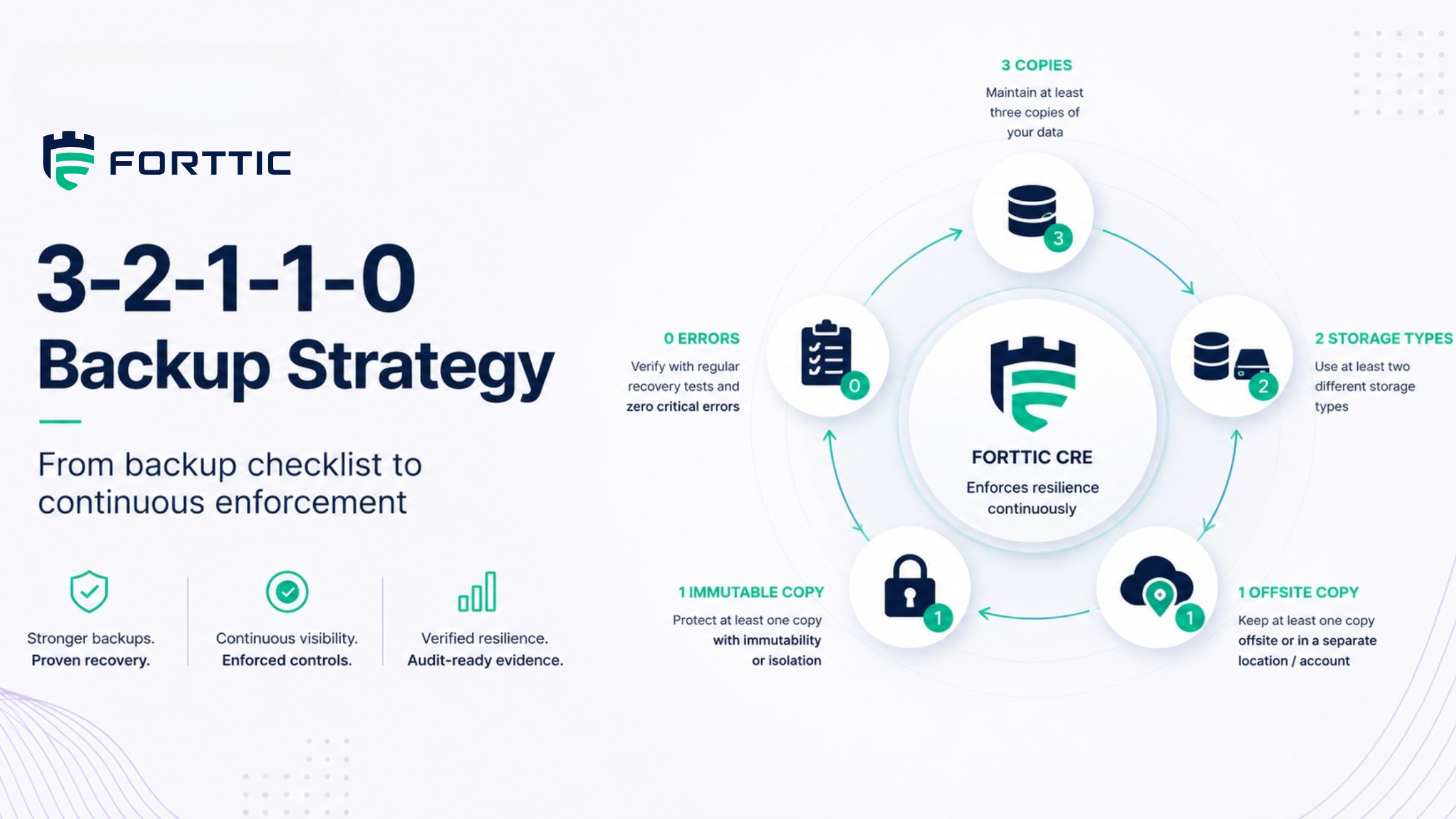
The 3-2-1-1-0 rule is simple. Enterprise enforcement is not.
The 3-2-1-1-0 backup strategy has become one of the most widely recognized models for protecting data against infrastructure failure, accidental deletion, ransomware, and broader operational disruption. Its appeal comes from its simplicity. Rather than relying on a single backup copy or a single storage system, the framework encourages organizations to create multiple layers of protection and to validate that those layers can support recovery.
On paper, the framework is straightforward: maintain three copies of data, store them across two different media or storage types, keep one copy offsite or appropriately separated, protect one copy through immutability or isolation, and confirm zero errors through recovery verification.
In practice, however, modern enterprise environments rarely remain static long enough for a one-time checklist to provide lasting assurance. New cloud accounts are created, workloads move between regions, backup policies change, storage classes are modified, retention periods drift, application owners change, and new vendors are introduced. A control that was compliant last quarter may no longer be compliant today.
This is why 3-2-1-1-0 should not be treated only as a backup architecture recommendation. It should be treated as a continuously governed resilience control.
What does 3-2-1-1-0 mean?
The first number, three, refers to maintaining at least three copies of important data. This usually means one production copy and two backup copies. The purpose is to reduce dependence on a single backup artifact or recovery path. If one copy becomes unavailable, corrupted, deleted, or compromised, another recovery option should remain.
The second number, two, refers to using at least two different storage types or protection mechanisms. The exact implementation varies by environment. An enterprise may combine snapshots with object storage, cloud-native backups with a third-party backup platform, or operational recovery copies with longer-term archival storage. The principle is to avoid having every copy fail because it depends on the same storage technology, control plane, account, or failure domain.
The first one refers to keeping at least one copy offsite or sufficiently separated from the primary environment. In cloud environments, this may mean cross-account, cross-region, or logically separated storage rather than a traditional physical offsite facility. The important question is whether a compromise or operational failure in the primary environment could also destroy or block access to the recovery copy.
The second one refers to maintaining one immutable, air-gapped, or otherwise isolated copy. This is particularly important for ransomware resilience. A backup copy that can be deleted or encrypted using the same compromised credentials as the production system may not provide meaningful protection.
The zero represents zero recovery errors. This is the part most often reduced to backup job status, but it should be interpreted more broadly. Zero errors means that backup processes are monitored, restore paths are tested, data integrity is checked, dependencies are understood, and recovery evidence demonstrates that the protected workload can actually be restored.
Why successful backup jobs do not prove 3-2-1-1-0 compliance
A backup platform can show that a job completed successfully without proving that the workload satisfies the complete 3-2-1-1-0 model.
A successful snapshot may count as a copy, but it may still reside in the same account, region, or administrative boundary as the production workload. Two backup artifacts may exist, but both may depend on the same storage service or identity controls. An immutable copy may be configured, but only for certain workloads. A restore test may have succeeded six months ago, even though the application architecture has changed since then.
Job success answers a narrow operational question: did the backup process complete?
Resilience requires a wider set of answers. How many valid copies exist? Where are they stored? Are they appropriately separated? Can privileged users modify or delete them? Are retention policies still aligned with business requirements? Has the recovery process been tested against the current application configuration? Is there evidence that the control remains effective?
This gap between backup execution and resilience assurance is where governance becomes necessary. Related reading: recovery proof as the new backup evidence.
How 3-2-1-1-0 drift appears in modern environments
Drift rarely appears as one dramatic control failure. It accumulates through small operational changes.
A cloud team may deploy a new workload without applying the standard backup policy. An application may be moved to a new account while its recovery copy remains in the previous environment. A retention period may be shortened to reduce storage consumption without considering recovery requirements. An immutable vault may exist, but newly created workloads may not be enrolled automatically.
Ownership can drift as well. A platform team may manage the infrastructure, while a backup team manages protection policies and an application team owns recovery priorities. When no team has end-to-end accountability, gaps remain unresolved because each group sees only part of the control.
Multi-vendor environments add another layer of complexity. An organization may use cloud-native backup services for some workloads, a third-party platform for others, snapshots for rapid operational recovery, and object storage for longer-term retention. Each system may report its own activity accurately while no single view confirms whether the overall enterprise satisfies 3-2-1-1-0.
This is why periodic reviews become unreliable at scale. By the time a spreadsheet or audit sample is completed, the environment may already have changed. In multi-account AWS estates, that pattern often shows up as AWS backup drift.
From checklist compliance to continuous enforcement
A checklist is useful for defining the expected control. It is less effective for ensuring that the control remains active over time.
Continuous enforcement starts by translating 3-2-1-1-0 into measurable conditions. Which workloads require three copies? What qualifies as a distinct storage type? What separation model is acceptable for each environment? Which copies must be immutable? How frequently should recovery be verified? Who owns remediation when drift is detected?
Once those rules are defined, the environment must be continuously assessed against them.
This creates an operational loop:
- Discover: Identify cloud accounts, workloads, backup assets, snapshots, vaults, policies, retention rules, recovery tests, and ownership relationships.
- Assess: Compare the current environment against approved 3-2-1-1-0 requirements and identify missing copies, insufficient separation, immutability gaps, untested recovery paths, and evidence gaps.
- Enforce: Route findings to the appropriate team, apply approved guardrails, or trigger remediation workflows.
- Verify: Confirm that the issue was corrected and that recovery readiness has been restored.
- Report: Maintain timestamped evidence showing what was evaluated, what drifted, what changed, and whether the control is currently effective.
This is the foundation of Continuous Resilience Enforcement. See the full model on the CRE Framework page, or start with What is CRE?.
Configuration is not continuous enforcement
Documenting 3-2-1-1-0 once is easy. Proving every critical workload still meets it after accounts, policies, and owners change is the real control. That is the shift from checklist to Continuous Resilience Enforcement.
What each part of 3-2-1-1-0 should prove
For the three-copy requirement, enterprises should be able to prove that each critical workload has the required number of usable copies. The count should exclude expired, corrupted, inaccessible, or operationally meaningless artifacts. Three records in a console do not necessarily represent three viable recovery options.
For the two-storage-type requirement, the organization should demonstrate meaningful diversity. Merely storing multiple copies under the same failure domain may create the appearance of redundancy without reducing risk. The storage architecture should be evaluated against the actual threats and outages the organization is trying to withstand.
For the offsite or separated copy, evidence should show that the copy cannot be lost through the same incident affecting production. In cloud environments, this requires examining accounts, regions, credentials, control planes, replication paths, and administrative boundaries.
For the immutable or isolated copy, the organization should prove that the copy is protected against unauthorized modification and premature deletion. It should also verify that immutability settings apply to the required workloads and retention periods rather than only to a small subset of the estate.
For zero errors, the enterprise should maintain evidence that backups complete, integrity checks pass, restore procedures are exercised, dependencies are understood, and failures are remediated. The aim is not to claim that incidents will never occur. The aim is to ensure that unresolved errors and unverified recovery paths are not accepted as normal. After a workload moves, check each protection requirement after change instead of assuming the previous 3-2-1-1-0 evidence still applies.
Why recovery testing must be part of the model
Recovery testing is the difference between assuming that protection works and demonstrating that it works.
A backup artifact may be technically valid while the application remains unrecoverable. Identity dependencies may be missing. Network configuration may no longer match. Encryption keys may be unavailable. Recovery instructions may refer to infrastructure that has since changed. The data may restore, but the application may not return to an operational state.
For this reason, recovery verification should be risk-based and repeated. Critical workloads may require more frequent or more complete testing than lower-priority systems. Some environments may support automated restore validation, while others require controlled exercises involving infrastructure, application, security, and business teams.
The important principle is that recovery evidence should reflect the current environment. A successful test from a year ago does not prove that today’s application, credentials, dependencies, and operating procedures will work.
Applying 3-2-1-1-0 across clouds and backup vendors
Most enterprises do not operate within a single backup product or cloud platform. They may use AWS Backup, Azure Backup, Google Cloud backup services, Veeam, Commvault, Druva, Clumio, snapshots, replication, archival storage, and internally developed recovery workflows.
This diversity is not necessarily a weakness. Different tools may be appropriate for different workloads. The governance problem begins when each platform is evaluated separately and no one can determine whether the combined environment satisfies enterprise resilience requirements.
A continuous enforcement layer should connect to the individual protection systems. It should understand which workload is protected by which service, how many copies exist, where those copies are located, which policies apply, whether immutability is active, when recovery was last verified, and who owns the control.
The goal is not to replace the existing backup stack. It is to govern the resilience outcome across that stack. See vendor coverage and posture vs. enforcement.
The role of Continuous Resilience Enforcement
Continuous Resilience Enforcement, or CRE, turns 3-2-1-1-0 from a recommended architecture into an operating model.
Backup tools continue to protect the enterprise and run recovery activities. Posture tools may continue to identify configurations and risks. CRE closes the loop by connecting discovery, assessment, enforcement, verification, and evidence.
This is particularly important for organizations with multiple clouds, accounts, business units, and backup platforms. Without an enforcement layer, findings often remain in reports or dashboards waiting for manual ownership and follow-up. With continuous enforcement, gaps can be assigned, tracked, verified, and documented as part of an ongoing control process.
The result is not simply better backup reporting. It is stronger recovery confidence.
What good 3-2-1-1-0 governance looks like
A mature organization should be able to answer several questions without launching a lengthy manual audit.
- Which critical workloads currently fail one or more parts of 3-2-1-1-0?
- Which copies are immutable?
- Which workloads have not been recovery-tested within the approved interval?
- Which policies have drifted from the enterprise standard?
- Which account, application owner, or infrastructure team is accountable for each gap?
- What remediation occurred, and when was it verified?
The organization should also be able to distinguish between configuration and evidence. A policy may be configured correctly while no evidence exists that it is applied to every required workload. A recovery test may be scheduled while no evidence confirms that it completed successfully. A copy may be labelled immutable while its retention or administrative controls do not meet the enterprise standard.
Good governance requires both the control and the proof. Not sure where you sit today? Run the free CRE assessment.
Move beyond the checkbox
The 3-2-1-1-0 rule remains a practical foundation for modern backup resilience. But the value of the framework depends on whether it remains effective after the environment changes.
Enterprises should not have to wait for a quarterly review, ransomware event, audit request, or failed recovery to discover that backup controls have drifted. They need a continuous way to understand coverage, enforce standards, verify recovery, and produce evidence.
That is the shift from backup configuration to resilience governance.
Forttic connects business resilience requirements to the systems protecting the enterprise, continuously checking whether those requirements are being met.
Frequently asked questions
What is the 3-2-1-1-0 backup strategy?
The 3-2-1-1-0 backup strategy recommends maintaining three copies of data, using two different storage types, keeping one copy offsite or separated, protecting one copy through immutability or isolation, and verifying zero recovery errors.
Is 3-2-1-1-0 only for ransomware protection?
No. It is useful for ransomware resilience, but it also protects against accidental deletion, hardware failure, cloud outages, administrative mistakes, corrupted data, policy drift, and other operational disruptions.
Does a successful backup job prove 3-2-1-1-0 compliance?
No. A successful job confirms that a backup operation completed. It does not prove that enough usable copies exist, that they are properly separated, that an immutable copy is protected, or that the recovery process works.
What counts as an offsite copy in a cloud environment?
An offsite or separated copy may be stored in another account, region, cloud platform, storage system, or administrative boundary. The important consideration is whether the same incident could compromise both production and the recovery copy.
Why is immutability important?
Immutability helps prevent backup copies from being modified or deleted before the approved retention period ends. This can protect recovery data from ransomware, compromised credentials, malicious insiders, and accidental deletion.
How does Continuous Resilience Enforcement support 3-2-1-1-0?
CRE continuously discovers backup assets, assesses them against approved resilience requirements, identifies drift, supports enforcement and remediation, verifies recovery readiness, and produces timestamped evidence across clouds and backup vendors. See What is CRE? and the CRE Framework.
Does Forttic replace existing backup tools?
No. Forttic is designed to work with existing cloud and backup tools. It provides continuous governance across the environment rather than replacing the platforms that protect and recover the enterprise. See vendor coverage.