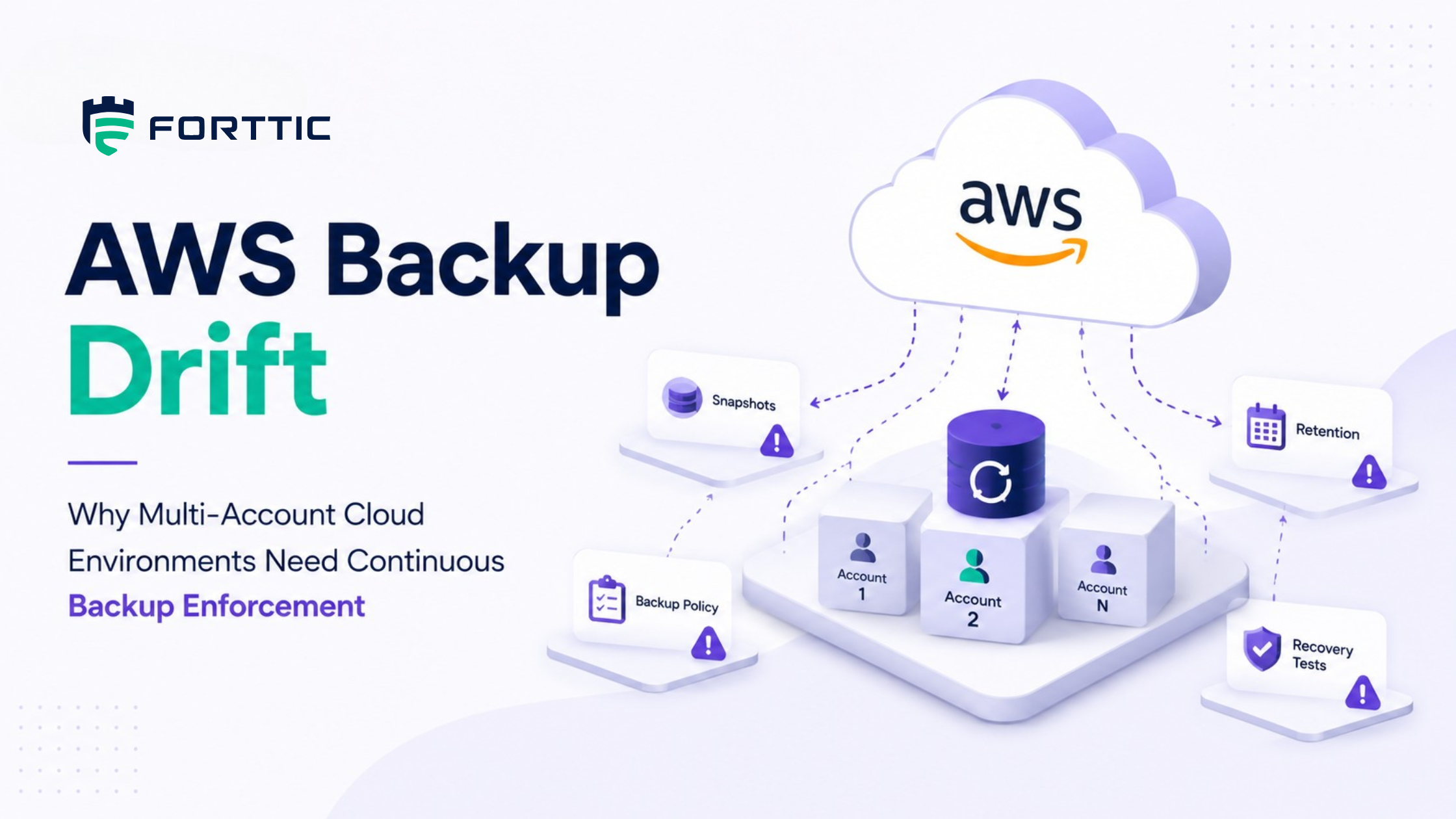
Multi-account AWS changed the backup problem
AWS gave infrastructure teams speed, flexibility, and scale. It also changed the shape of backup risk.
In a small cloud environment, backup governance can be handled with a manageable set of policies, a few accounts, and a small group of owners who understand what is critical. As organizations scale, that simplicity disappears. Production accounts multiply. Development, staging, analytics, AI, security, and regional accounts appear. Teams adopt Terraform, AWS Organizations, EKS, RDS, EBS, S3, AWS Backup, snapshots, vaults, replicas, and third-party backup vendors. Workloads move faster than the governance model built around them.
This is where backup drift begins.
Backup drift does not always look like a dramatic failure. It often starts quietly. A workload is launched outside the standard policy. A snapshot remains after the volume it protected is gone. A retention rule is extended temporarily and never reviewed. A database is migrated, but the recovery test is not repeated. A team assumes AWS Backup covers a workload because it exists in the account, but the workload is not attached to the right plan. A region is added for performance or data residency, but backup separation and restore paths are not revalidated.
No single event feels urgent enough to trigger a major review. But over time, the environment no longer matches the resilience posture the organization believes it has.
That is the problem with backup drift. It grows in the space between cloud speed and governance discipline.
Backup job success is not recovery proof
A green backup job is useful, but it is not the same as recovery proof.
This distinction matters in AWS because many different layers can appear healthy in isolation. AWS Backup may show completed jobs. EBS snapshots may exist. RDS automated backups may be enabled. S3 versioning may be active. Backup vaults may be configured. A third-party tool may report successful protection for part of the estate. Each signal tells you something, but none of them alone answers the question the business ultimately cares about: can the organization recover the service when it matters?
Recoverability depends on context. A workload must be identified, classified, protected by the right policy, stored with the right retention, separated from the right failure domains, protected against tampering, tested through a meaningful recovery path, and documented with evidence. If any part of that chain drifts, the backup job can still look successful while recovery confidence declines.
This is especially important for tier-1 workloads. A payment system, customer-facing application, healthcare data store, logistics platform, or internal operational system cannot be evaluated by backup existence alone. The organization needs to know whether the recovery path works, whether dependencies are included, whether credentials are protected, whether backup copies are isolated, and whether the last meaningful restore produced usable results.
AWS backup drift is not just an infrastructure hygiene problem. It is a reliability, security, FinOps, and governance problem — the same gap that separates observation from enforcement in our posture vs. enforcement model.
Where AWS backup drift commonly appears
In multi-account AWS environments, drift usually appears across five areas: coverage, retention, cost, recovery testing, and evidence.
Coverage drift
New workloads are created faster than backup governance can classify and protect them. This is common in platform-led organizations where teams self-serve infrastructure. An EKS cluster, RDS instance, EC2 workload, EBS volume, or S3 bucket may support important activity before backup ownership is clear. Infrastructure-as-code improves consistency, but it does not automatically guarantee that every workload is mapped to the right recovery policy.
Retention drift
Policies no longer match business requirements. Some backups are kept longer than needed. Others are not kept long enough. Temporary exceptions become permanent. Account-level defaults may not reflect workload-level criticality. A development snapshot may persist for months while a production recovery policy is still dependent on assumptions that no longer hold.
Cost drift
Orphaned EBS snapshots, duplicate snapshots, stale volumes, and over-retained backups accumulate across accounts. FinOps teams may see rising storage costs, but not always know which costs are required for resilience and which reflect unmanaged drift. Backup cost is rarely just a cost issue — it usually points to a deeper governance issue.
Recovery testing drift
Backup configuration changes but recovery validation does not keep pace. A workload is migrated, refactored, reclassified, or moved into a new account. The backup policy may be updated, but the restore path may not be tested again. In many teams, recovery testing is periodic, manual, or limited to a small subset of systems.
Evidence drift
The proof of resilience is scattered. Backup status may live in AWS. Restore evidence may live in tickets. Policy exceptions may live in documents. Ownership decisions may live in Slack threads, email, or tribal memory. At audit time, insurance renewal time, or incident time, teams are forced to reconstruct the story manually — the same pressure that drives continuous evidence packages under frameworks like DORA Article 11.
These patterns are not unusual. They are the natural result of fast-moving cloud environments. The issue is not that teams are careless. The issue is that backup governance has not become continuous enough to match how cloud infrastructure actually changes.
Why AWS Backup alone is not the full governance layer
AWS Backup is an important execution layer for AWS-native protection. It helps teams create backup plans, assign resources, manage vaults, and centralize parts of backup operations. For AWS-primary organizations, it is often a strong foundation.
But AWS Backup is not the same thing as complete resilience enforcement.
Large enterprises often run more than one backup mechanism. They may use AWS Backup for cloud-native workloads, Veeam or Commvault for hybrid workloads, Druva for SaaS, native database backup features for certain systems, and storage-level replication for others. They may also operate across Azure, GCP, or on-prem environments alongside AWS. Even inside AWS, resilience depends on IAM, account design, region strategy, workload criticality, application dependencies, restore testing, and evidence workflows. See vendor coverage for how Forttic sits across that stack.
The governance question is larger than whether AWS Backup exists.
The stronger question is: across every account, workload, backup service, snapshot, vault, retention rule, and recovery path, can the organization continuously prove that backup resilience is being enforced?
That is where Continuous Resilience Enforcement becomes relevant. CRE does not replace AWS Backup. It sits above AWS Backup and the wider backup estate to discover drift, assess risk, enforce guardrails, verify recovery, and report evidence.
This distinction is important for enterprise buyers. The goal is not to add yet another backup tool. The goal is to enforce backup resilience across the tools already in place.
Cost as a wedge — not the category
Orphaned and over-retained snapshots give FinOps a concrete reason to investigate. But if the only message is savings, the problem gets reduced to cleanup. Snapshot waste usually signals unclear ownership and weak policy enforcement — the same context gap that creates recovery risk.
The FinOps wedge: snapshot waste as a symptom
For AWS-primary enterprises, orphaned and over-retained snapshots are often the easiest way to start the conversation.
Snapshot waste is visible, measurable, and financially relevant. It gives FinOps and cloud infrastructure teams a concrete reason to investigate backup governance. But the conversation should not stop at savings.
If a team cannot confidently say which snapshots are required, which are stale, which are tied to critical workloads, which exist for compliance reasons, and which can be safely removed, then the organization does not have a cost problem alone. It has a resilience context problem. The same lack of context that creates unnecessary spend can also create recovery risk.
A snapshot may be expensive but necessary. Another may be cheap but critical. A third may be useless but retained indefinitely because no one wants to take responsibility for deleting it. Without workload context, retention policy, business criticality, and recovery evidence, cleanup becomes risky.
This is why Forttic treats cost as a wedge, not as the category. The first conversation with Platform Engineering or FinOps can begin with snapshot waste. The deeper value is continuous backup enforcement: knowing what is protected, why it exists, whether it is recoverable, and whether the evidence is defensible.
What Continuous Resilience Enforcement changes
CRE changes the operating model from periodic review to continuous control. The full loop is documented on the CRE Framework page; here is how it maps to AWS drift.
- Discover — map cloud assets, accounts, workloads, snapshots, backup jobs, vaults, replicas, storage, IAM relationships, and vendor coverage. Drift cannot be governed if the environment is not continuously understood.
- Assess — evaluate posture against recovery policy, business criticality, 3-2-1-1-0 expectations, and compliance requirements. A missing backup on a low-priority sandbox does not carry the same weight as weak coverage for a tier-1 database.
- Enforce — move beyond visibility. Route or execute corrective actions within approved guardrails: flag missing coverage, escalate immutability concerns, recommend retention changes, or remediate account-level drift so findings do not remain passive alerts indefinitely.
- Verify — check whether recovery controls actually work: integrity, separation, immutability, and restore readiness. For critical workloads, verification should include meaningful recovery testing rather than assuming configuration equals recoverability.
- Report — produce evidence different stakeholders can use. Platform needs operational detail. FinOps needs waste and ownership context. SRE needs recovery confidence. Security needs exposure visibility. Compliance needs timestamped proof.
This is the shift from backup management to backup enforcement. Map your own gaps with the free CRE assessment.
How 3-2-1-1-0 applies to AWS environments
The 3-2-1-1-0 rule remains a clear resilience standard: three copies, two storage types, one offsite copy, one immutable or isolated copy, and zero errors verified through recovery testing.
In AWS, the challenge is not understanding the rule. The challenge is proving that it holds continuously across accounts, workloads, and services.
Three copies may be difficult to prove if workloads are spread across AWS Backup, EBS snapshots, RDS backups, object storage, and vendor-managed copies. Two storage types may require deeper analysis than simply counting services. One offsite copy depends on how the organization defines geographic and operational separation. One immutable copy requires monitoring of vault lock, object lock, permissions, and tamper resistance. Zero errors require restore validation, not just job completion.
A static policy cannot answer these questions for long. Cloud environments change too frequently. CRE turns 3-2-1-1-0 into a continuously enforced standard by checking whether the rule still holds as accounts, workloads, teams, and backup configurations evolve — the same operating model explained in What is Continuous Resilience Enforcement?
Why SRE and platform teams should care
Backup resilience is often treated as a backup administrator concern, but in cloud-native organizations it increasingly overlaps with SRE and platform engineering.
SRE teams care about reliability, service restoration, incident response, and measurable recovery objectives. A service is not reliable if it cannot be recovered. A recovery objective is not meaningful if the restore path is untested. An incident response plan is incomplete if backup evidence is unclear during a crisis.
Platform teams care because they create the paved roads that application teams use. If backup governance is not part of that paved road, resilience becomes inconsistent. Some teams follow the standard. Others work around it. Some workloads inherit the right policies. Others escape coverage.
CRE gives SRE and platform teams a shared control model. It does not ask them to manually inspect every backup console or chase every account owner. It creates a continuous loop that identifies drift, assesses impact, routes enforcement, verifies recovery, and reports evidence — making backup resilience part of the reliability operating model, not a separate afterthought.
From AWS drift to enterprise resilience evidence
The first sign of backup drift may be a cost anomaly, an orphaned snapshot, or a missing backup policy. But the broader issue is resilience evidence.
When a CISO, auditor, insurer, or executive asks whether critical workloads can recover, the organization needs more than account-level backup settings. It needs a credible evidence trail. What was protected? What changed? Who approved the change? Was the copy immutable? Was separation verified? Was recovery tested? What is still exposed? That broader shift — from job reports to recovery proof — is covered in Recovery proof is the new backup evidence.
This is why AWS backup drift is a useful starting point. It begins with a practical problem that platform and cloud teams recognize. It expands naturally into SRE reliability, FinOps governance, cyber resilience, compliance, and insurance readiness — the same forces covered on Why Forttic.
The message is not that AWS Backup is insufficient. The message is that AWS backup environments need a continuous enforcement layer as they scale.
Backup tools execute. Posture tools observe. Forttic enforces.
For AWS-primary enterprises, that enforcement layer is what turns backup activity into recovery confidence.
Frequently asked questions
What is AWS backup drift?
AWS backup drift is the gradual misalignment of backup coverage, retention, snapshots, policies, ownership, immutability, recovery testing, and evidence across AWS accounts and workloads. It often appears in multi-account environments where infrastructure changes faster than backup governance.
Why are successful AWS backup jobs not enough?
Successful backup jobs show that a backup process completed, but they do not prove full recoverability. Recovery also depends on retention, separation, immutability, workload dependencies, access controls, restore testing, and evidence that the recovery path works.
How do orphaned EBS snapshots relate to backup governance?
Orphaned EBS snapshots often indicate unclear ownership, weak retention governance, or missing workload context. They create cost waste, but they also reveal a deeper problem: teams may not know which backup artifacts are required for resilience and which are safe to remove.
Does Continuous Resilience Enforcement replace AWS Backup?
No. CRE does not replace AWS Backup. It sits above AWS Backup and other backup tools to discover drift, assess risk, enforce guardrails, verify recovery, and produce evidence across the backup estate. See What is CRE? for the full definition.
Why should SRE teams care about backup drift?
SRE teams are responsible for reliability and recovery outcomes. If critical services cannot be restored, reliability is incomplete. Backup drift affects recovery confidence, incident readiness, and the ability to meet recovery objectives.
How does CRE support 3-2-1-1-0 in AWS?
CRE helps continuously check whether AWS workloads meet 3-2-1-1-0 expectations: enough copies, appropriate storage diversity, offsite or separated copies, immutable protection, and verified recovery without errors. Details on the CRE Framework page.