Backup evidence is becoming a board-level concern
For a long time, backup evidence was treated as an IT operations artifact. A backup administrator could export job history, show that backups completed, point to a retention policy, and satisfy most internal reviews. In many organizations, this still works for routine checks. But it is no longer enough for serious resilience conversations.
The expectations around backup have changed because the stakes have changed. Ransomware has made backup systems a direct target. Cloud migration has spread recovery dependencies across accounts, regions, vendors, and teams. Regulators are asking more detailed questions about operational resilience. Cyber insurers are looking more closely at whether recovery controls actually reduce loss exposure. Boards and executives want to understand whether business-critical services can continue or recover during a disruption.
In that environment, evidence needs to show more than activity. It needs to show operating effectiveness.
A successful backup job says that a process completed. It does not prove that the copy is isolated from production failure, that it is immutable, that the right workloads are covered, that retention matches business requirements, that restore dependencies are included, or that the organization can recover within its stated objectives. A job report is a signal. Recovery proof is evidence.
This is the shift enterprises need to prepare for. Backup evidence is moving from proof of execution to proof of resilience — the same distinction we draw in posture vs. enforcement.
Why backup job reports are no longer enough
A backup job report answers one narrow question: did a backup task complete? That question still matters, but it is not the same as asking whether the organization is resilient.
Consider a cloud environment where backup jobs complete every night. On the surface, the posture may look healthy. But the business may still be exposed if a critical database was moved to a new account without the correct backup plan, if snapshots are retained without clear ownership, if immutable storage was weakened by an administrative change, if offsite separation is assumed but not validated, or if restore testing has not been performed since a major architecture change. Multi-account AWS estates are a common place this shows up as backup drift.
The problem is not that backup tools are failing. Backup tools are doing what they were built to do. They execute jobs, create copies, manage retention, and support recovery workflows inside their own scope. The gap appears when the enterprise needs to prove resilience across the full operating environment.
That proof depends on context. Which workloads are critical? Which backup copies protect them? Where are those copies stored? Are they separated from production risk? Are they immutable or protected from tampering? When was recovery last tested? What changed after the test? Who approved exceptions? Which gaps remain open? Which controls were active at the time of an incident, renewal, or audit?
Most enterprises can answer some of these questions manually. Fewer can answer them continuously. Even fewer can answer them across AWS, Azure, GCP, Veeam, Commvault, Druva, Clumio, AWS Backup, Azure Backup, Google Cloud Backup, and other systems without stitching together exports, tickets, spreadsheets, and tribal knowledge. See vendor coverage for how Forttic sits above that stack.
That is why recovery proof is becoming the new standard for backup evidence.
What regulators, auditors, and insurers actually want to understand
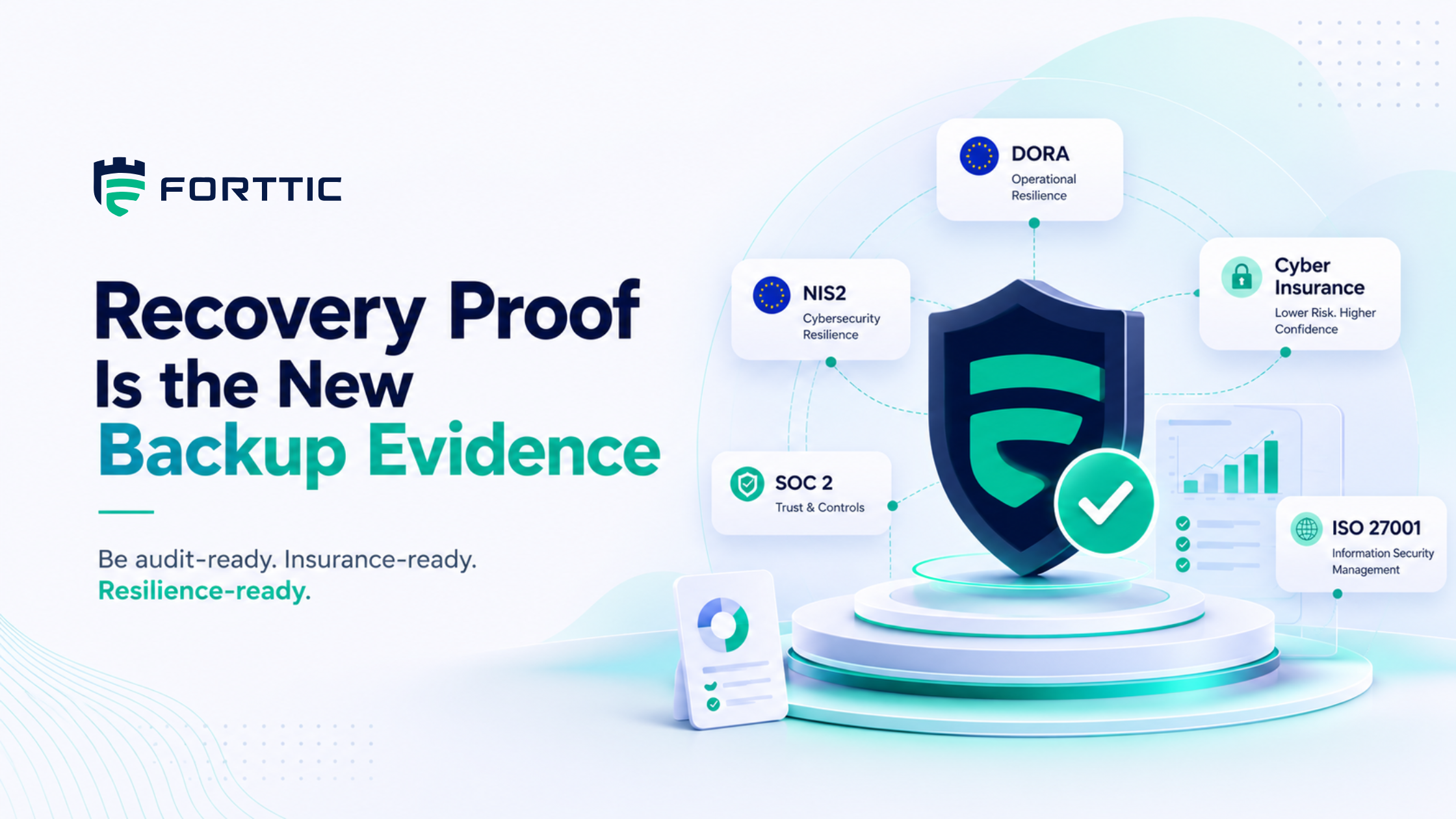
The language may differ across DORA, NIS2, SOC 2, ISO 27001, cyber insurance reviews, internal risk committees, and customer security questionnaires. But the underlying questions are often similar.
- Can the organization identify which systems are critical to business continuity?
- Can it prove those systems are protected by appropriate backup and recovery controls?
- Can it show backup copies are separated, retained, and protected from tampering?
- Can it demonstrate that recovery has been tested in a meaningful way?
- Can it explain what changed in backup posture over time — and produce evidence quickly?
These are not just documentation questions. They are governance questions.
A screenshot from a backup console may show that a job succeeded. It does not necessarily show whether the backup is aligned to the correct business criticality, whether the recovery plan includes dependencies, whether an exception was approved, whether a control was continuously monitored, or whether a restore was validated after the last major change.
Cyber insurers may focus on ransomware recovery and business interruption exposure. Regulators may focus on operational resilience and ICT continuity. Auditors may focus on control design and operating effectiveness. For a DORA-specific package, start with our DORA Article 11 evidence playbook.
The evidence package needs to serve all of them. That requires a stronger model than periodic exports.
The five evidence carriers of modern backup resilience
A credible backup resilience evidence package usually contains five types of evidence.
1. Configuration posture
This shows whether backup controls are configured according to policy: retention rules, backup plans, vault settings, immutability, encryption, separation, access controls, and coverage expectations. Configuration posture is the foundation, but it is not sufficient on its own because configuration can drift.
2. Recovery test records
These show whether systems have actually been restored or validated. A recovery test record should identify the workload, scope, date, environment, result, and any follow-up actions. For critical workloads, the most useful evidence is not a lightweight confirmation that data exists. It is proof that a recovery path works in a controlled environment.
3. Drift remediation history
This shows what changed, when it changed, why it mattered, and how it was resolved. Backup resilience is not static. Workloads move, policies change, snapshots age, permissions drift, and teams make exceptions. The evidence needs to show that the organization detected drift and acted on it, not merely that it had an ideal policy document.
4. Coverage map
This connects business-critical assets to backup and recovery controls. It should show which workloads are protected, under-protected, excluded, or requiring attention. In a multi-cloud or cross-vendor estate, the coverage map is often the missing piece because no single backup console sees the entire resilience surface.
5. Decision audit trail
This records approvals, exceptions, escalations, guardrails, and ownership. If retention was changed, who approved it? If a workload was excluded, why? If remediation was deferred, what was the risk rationale? If an automated action was taken, under which policy or guardrail did it occur? Without a decision trail, teams can show outcomes but struggle to explain governance.
Together, these five evidence carriers move an organization from backup reporting to resilience proof.
Scheduled testing + continuous enforcement
A restore test captures a point in time. Cloud environments do not stand still between tests. Mature programs use periodic deep testing for critical systems and continuous signals between those tests — coverage changes, immutability weakening, separation drift, and unresolved gaps.
Why quarterly restore testing is not enough by itself
Scheduled restore testing is valuable. Enterprises should not abandon it. A well-run restore test can reveal dependency gaps, runbook issues, access problems, and recovery-time assumptions that configuration reviews will never expose. The issue is not that quarterly or annual testing is useless. The issue is that it is incomplete.
By the next scheduled test, the environment may no longer match the one that was previously validated. New workloads are launched. Databases are migrated. Kubernetes clusters change. Storage policies are adjusted. IAM roles are modified. Backup vendors are added or retired. Regions are introduced. Retention settings are altered.
Enterprises need periodic deep testing for critical systems, but they also need continuous signals between those tests. A mature resilience program uses scheduled testing and continuous enforcement together. The scheduled test proves depth. Continuous enforcement proves operating discipline over time.
How Continuous Resilience Enforcement creates recovery proof
CRE gives enterprises an operating model for producing recovery proof continuously. The full loop is on the CRE Framework page; here is how it maps to evidence.
- Discover — map cloud services, workloads, databases, storage, backup jobs, snapshots, replicas, vaults, SaaS protection, IAM, and backup-vendor coverage. Discovery must be continuous because the environment is continuous.
- Assess — evaluate against business criticality, recovery objectives, 3-2-1-1-0 expectations, compliance requirements, and policy guardrails. Distinguish minor issues from real recovery exposure.
- Enforce — move beyond observation. Route or execute approved actions within guardrails so findings do not remain passive alerts indefinitely — the gap posture tools leave open.
- Verify — confirm whether the control works: integrity, separation, immutability, or recovery testing for priority workloads. Verification turns configuration into confidence.
- Report — produce the timestamped evidence trail auditors, insurers, CISOs, infrastructure leaders, and executives can use.
This loop does not simply generate a report. It continuously creates the conditions that make the report credible. Map your gaps with the free CRE assessment.
3-2-1-1-0 as an evidence framework
The 3-2-1-1-0 rule is often discussed as a backup architecture principle. It is also useful as an evidence framework.
- Three copies — proof that multiple recoverable copies exist for the right workloads.
- Two storage types — proof that copies are not concentrated in one technical dependency.
- One offsite copy — proof of geographic or operational separation.
- One immutable or isolated copy — proof that backup data is protected from tampering.
- Zero errors — proof that recovery has been verified, not merely assumed.
In a multi-cloud or cross-vendor estate, the evidence becomes harder to maintain. CRE makes 3-2-1-1-0 measurable over time by checking whether the standard still holds as the environment changes — the same operating model in What is Continuous Resilience Enforcement?
It is not enough to say the standard is followed. The organization must be able to show how it is enforced.
What this means for CISOs, cloud teams, and compliance leaders
For CISOs, recovery proof changes backup from a technical dependency into a cyber resilience control — whether the organization can recover from ransomware, whether backup systems are protected from tampering, and whether the evidence will stand up during an incident or review. See Why Forttic for the insurance and ransomware context.
For cloud and platform teams, recovery proof reduces ambiguity. It shows which accounts, workloads, snapshots, vaults, and backup policies are aligned — and which are drifting. It also helps separate cost cleanup from resilience-critical protection, especially in AWS environments with snapshot sprawl.
For SRE and infrastructure teams, recovery proof connects backup to reliability. A system that cannot be restored is not truly reliable, even if it performs well under normal conditions.
For compliance and risk teams, recovery proof reduces audit friction. Instead of manually assembling evidence before a review, teams can rely on timestamped records produced by the same operating loop that manages backup resilience.
For MSPs and service partners, recovery proof creates a recurring service opportunity: continuous resilience enforcement, evidence reporting, and remediation support — not a one-time backup implementation.
From backup reporting to resilience assurance
The backup conversation is changing because the enterprise risk conversation is changing. Backup can no longer be treated as a passive safety mechanism that is assumed to work because jobs completed. It has become an active resilience control that must be governed, tested, enforced, and evidenced.
This does not mean enterprises need to replace their backup stack. Most already have the tools required to execute backups. The missing layer is the one that governs recovery outcomes across those tools.
That is the role of Continuous Resilience Enforcement.
CRE turns backup evidence into a living record. It shows what exists, what is protected, what drifted, what was enforced, what was verified, and what can be proven. It helps enterprises move from reactive audit preparation to continuous resilience assurance.
The question for modern organizations is no longer whether backups exist. It is whether the organization can prove recovery continuously, across every cloud, every vendor, every critical workload, and every control that recovery depends on.
Backup tools execute. Posture tools observe. Forttic enforces.
That is the difference between having backup reports and having recovery proof.
Frequently asked questions
What is recovery proof?
Recovery proof is evidence that backup and recovery controls actually work. It goes beyond backup job status by showing coverage, retention, separation, immutability, recovery testing, remediation history, and timestamped evidence for critical workloads.
Why are backup job reports not enough for audits or insurance reviews?
Backup job reports show that backup tasks completed, but they do not prove that systems can recover. Auditors, insurers, and regulators often need evidence of control effectiveness, recovery testing, immutability, separation, and change history.
How does Continuous Resilience Enforcement help with recovery evidence?
CRE continuously discovers backup assets, assesses drift, enforces guardrails, verifies recovery, and reports timestamped evidence. This creates a stronger evidence trail than periodic manual reporting. See What is CRE?
How does 3-2-1-1-0 relate to recovery proof?
The 3-2-1-1-0 rule becomes evidence-ready when each part is continuously verified: three copies, two storage types, one offsite copy, one immutable or isolated copy, and zero errors through recovery testing. Details on the CRE Framework page.
Does recovery proof require replacing existing backup tools?
No. Recovery proof can be built above existing backup tools and cloud services. The goal is to govern and verify the resilience outcome across the stack, not replace the systems that execute backups.
Who needs recovery proof inside an enterprise?
Recovery proof is useful for CISOs, cloud platform teams, SRE teams, backup administrators, compliance teams, risk leaders, cyber insurance stakeholders, infrastructure leaders, and MSP partners.