Backup resilience has outgrown the backup console
For years, backup success was measured inside backup tools. A job ran, a snapshot was created, a replication task completed, and the dashboard showed green. That model worked when infrastructure was simpler, ownership was centralized, and recovery expectations were mostly internal. It no longer fits how modern enterprises operate.
Today, backup estates are fragmented across cloud platforms, SaaS applications, databases, object storage, virtual machines, Kubernetes clusters, native backup services, and enterprise backup vendors. A single organization may run AWS Backup for some workloads, Veeam for others, Commvault for regulated systems, Druva for SaaS coverage, and native Azure or Google Cloud backup capabilities in parallel. Each tool may execute its own part of the recovery plan correctly, but the business still needs one answer: can we recover when it matters? In multi-account AWS estates, that gap often shows up as backup drift — policies, snapshots, and recovery evidence falling out of sync across accounts.
That answer cannot be found by looking at job status alone. A backup job can complete successfully while the underlying recovery posture is still weak. Copies may not be geographically separated. Retention may be misaligned with policy. Immutability may be disabled or misconfigured. Credentials may not be isolated from production admin access. Critical workloads may never have been restored in a clean environment. Audit evidence may exist only as screenshots, spreadsheets, and manual exports gathered before a review.
This is the gap Continuous Resilience Enforcement is designed to close.
CRE starts from a simple premise: backup is no longer just a data protection function. It is an operational resilience control. That means it has to be continuously discovered, assessed, enforced, verified, and reported across the full estate — not checked periodically inside separate tools.
What is Continuous Resilience Enforcement?
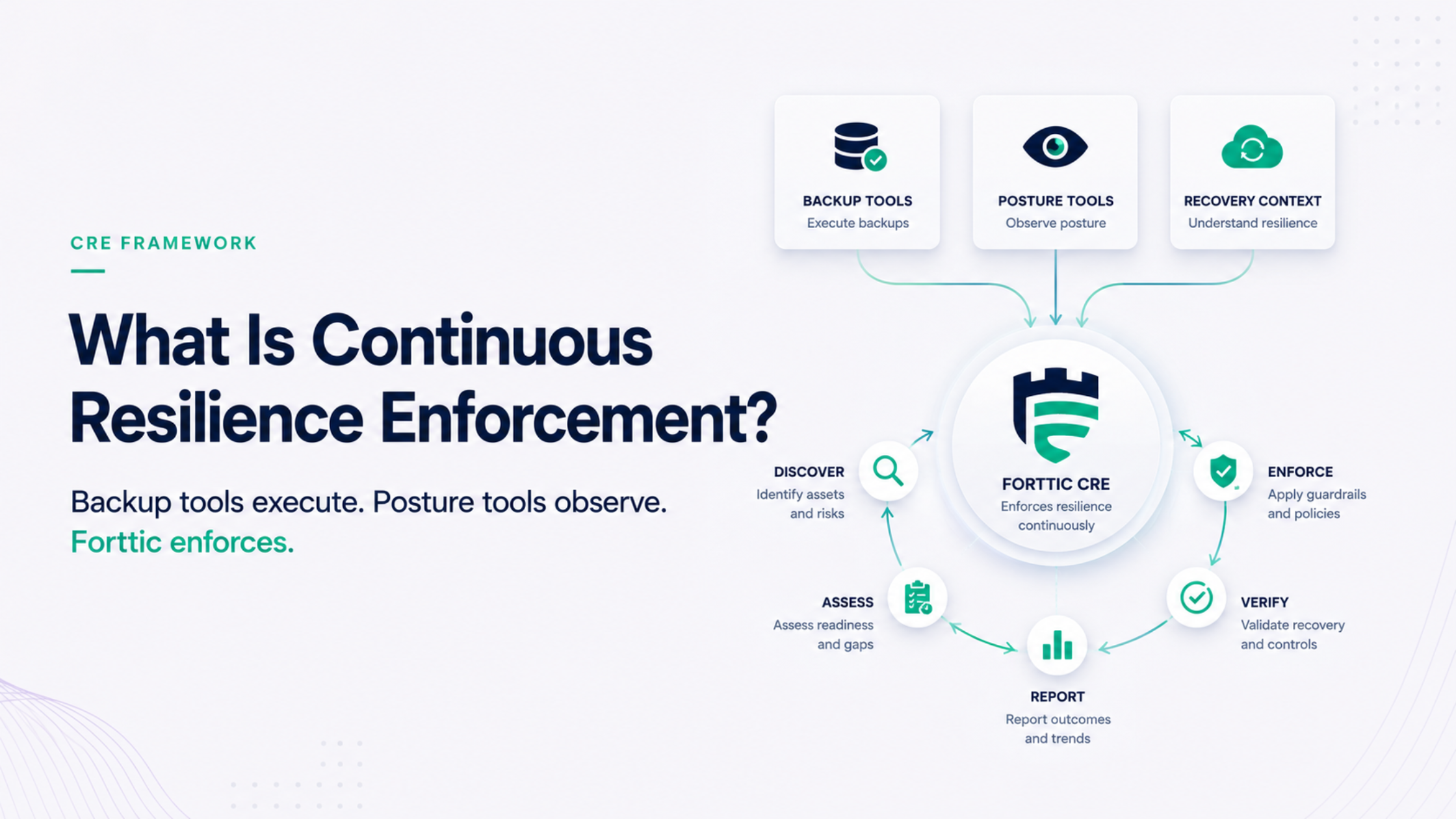
Continuous Resilience Enforcement, or CRE, is a continuous operating model for governing backup resilience across clouds, vendors, accounts, and business-critical workloads. It sits above the existing backup stack. It does not replace backup software. Instead, it coordinates the resilience layer that backup tools, posture tools, cloud teams, security teams, compliance teams, and infrastructure leaders all depend on.
The easiest way to understand CRE is through the distinction between three layers.
Backup tools execute
They create backups, snapshots, replicas, vaults, archives, and recovery workflows inside their own vendor or cloud environment. They are necessary, and enterprises should keep using them.
Posture tools observe
They scan configurations, surface drift, and show where something may be misaligned. They help teams understand exposure, but observation alone does not guarantee that recovery risk will be resolved.
CRE enforces
It connects discovery, risk assessment, action, verification, and evidence into one continuous loop. It does not stop at showing that something is wrong. It helps determine what should change, executes or routes remediation within guardrails, verifies whether the change worked, and produces evidence that the control is operating over time.
The core shift
CRE is not another dashboard for backup visibility. It is the enforcement layer that turns backup resilience into a live, auditable, continuously improving control. Backup tools execute. Posture tools observe. CRE enforces.
Why backup jobs are not the same as recoverability
The phrase “our backups are running” can create a false sense of safety. It tells you that a technical process has occurred, but it does not prove that the business can recover. Recovery depends on more than job execution.
A workload may be backed up, but not covered by the right retention policy. A snapshot may exist, but be orphaned from the workload it was meant to protect. A backup copy may be stored in the same operational failure domain as production. A vault may be configured, but not locked. A recovery plan may exist, but never have been tested under clean-room conditions. A restore may recover data, but not the full application dependency chain required to bring the service back.
This distinction matters because ransomware, regulatory examinations, cyber insurance reviews, and executive resilience reviews all ask harder questions than “did the job run?” They ask whether critical services can actually be restored, whether recovery objectives are measurable, whether backup controls were operating at the relevant time, and whether the organization can prove it without reconstructing the evidence manually.
Traditional backup operations often struggle here because the evidence is fragmented. Cloud metadata sits in one place. Backup job history sits in another. Restore-test results may live in tickets, documents, or team memory. Ownership may be split across infrastructure, security, application, compliance, and platform teams. When an auditor, insurer, regulator, or incident commander asks for proof, the organization has to assemble the picture under pressure.
CRE changes that operating model by treating recoverability as something that must be continuously enforced and continuously evidenced.
The CRE loop: Discover, Assess, Enforce, Verify, Report
CRE works as a decision loop. The loop is not a one-time assessment or quarterly review. It runs continuously as cloud accounts change, workloads move, backup policies drift, vendors are added, and business priorities shift. See the full diagram on the CRE Framework page.
1. Discover
An enforcement layer needs a reliable view of what exists before it can judge whether resilience is adequate. Discovery includes cloud services, compute, databases, storage, network configuration, IAM, backup jobs, snapshots, replicas, vaults, retention rules, immutability settings, and recovery topology. In a multi-cloud or multi-vendor estate, this asset graph matters because no individual backup console sees the whole environment.
2. Assess
Once the estate is discovered, every asset and backup relationship needs to be evaluated against policy, regulation, business criticality, and recovery objectives. A tier-1 payments workload should not be treated the same way as a low-criticality development dataset. CRE makes this assessment continuous, so risk is re-evaluated as posture changes rather than waiting for the next audit or manual review.
3. Enforce
This is where CRE separates itself from posture management. If a backup job is disabled, retention is wrong, replication has drifted, encryption is missing, or immutability has been weakened, the system should not merely create another alert. It should either remediate within approved guardrails or escalate the right action to the right owner with the right context. Enforcement does not mean reckless automation. It means controlled action, auditability, approval paths, and consistent policy execution across the estate.
4. Verify
Backup resilience is not proven until recovery has been tested. Verification can include integrity checks, immutability validation, cross-region or cross-account checks, and clean-room restore testing for critical workloads. Some recovery requirements cannot be confirmed by inspecting configuration alone. The only way to know whether a backup can save the business is to verify recovery outcomes.
5. Report
Enterprises need evidence that is useful to different stakeholders. Architects need operational views. Cloud teams need drift and remediation detail. CISOs need risk context. Compliance teams need control-mapped evidence. Executives need confidence that resilience is being governed over time. CRE reporting should produce timestamped evidence that shows what was protected, what changed, what was enforced, what was verified, and what still requires attention.
Together, these five stages move backup resilience from a periodic checklist to a continuous control loop. Not sure where your estate sits today? Run the free CRE assessment.
CRE and the 3-2-1-1-0 standard
The 3-2-1-1-0 backup rule remains one of the clearest ways to explain modern backup resilience: maintain three copies of data, use two different media or storage types, keep one copy offsite, keep one copy immutable or air-gapped, and verify zero errors through recovery testing.
The problem is not that enterprises ignore the rule. Many teams configure parts of it. The problem is that configuration is not the same as continuous enforcement.
- Three copies may exist today and drift tomorrow when retention fails, replication breaks, or a workload moves to a new account.
- Two storage types may appear diverse until concentration risk still exists inside one cloud provider, one region, or one vendor control plane.
- One offsite copy may be assumed because data is in another availability zone — even when required separation should be validated against geography and failure domains.
- One immutable copy may be configured, but not continuously checked for tampering, mode changes, or policy weakening.
- Zero errors cannot be claimed from configuration at all; it requires actual recovery verification.
CRE makes 3-2-1-1-0 operational. It continuously checks whether each layer still holds as the environment changes. It identifies when copy count, storage diversity, geographic separation, immutability, or restore confidence has drifted. It connects that drift to business impact and enforcement actions. Most importantly, it turns the standard into evidence that can be shown to security, compliance, insurance, and executive stakeholders.
This is why CRE is not just a backup engineering framework. It is also a governance model. For how Forttic maps each layer in practice, see CRE Framework and Posture vs. enforcement.
Why enterprises need CRE now
The need for CRE is increasing because three forces are converging.
Ransomware
Attackers understand that backups are the safety net. If they can compromise, encrypt, delete, or weaken backups, they increase leverage during an incident. A resilience program that only proves backups existed at some point in the past is not enough. Organizations need to know whether immutable copies are still intact, whether credentials are isolated, whether recovery paths are tested, and whether critical workloads can be restored cleanly.
Regulation and audit pressure
Operational resilience requirements are becoming more explicit, especially for regulated industries. Auditors and regulators increasingly care about operating effectiveness over time, not just policy existence. A backup policy document does not prove that backup controls were functioning. A quarterly restore test may help, but it does not show what happened between tests. CRE gives teams a way to produce continuous, timestamped evidence instead of relying on manual audit preparation — see recovery proof as the new backup evidence, and the DORA Article 11 evidence package for a regulation-specific deep dive.
Cloud complexity
Multi-account AWS environments, hybrid cloud estates, Azure and GCP adoption, SaaS backup needs, Kubernetes workloads, object storage, and multiple backup vendors create resilience fragmentation. Each team may own part of the environment, but recovery failure does not respect org charts. CRE gives enterprises a control layer that can govern across vendors and clouds without requiring a rip-and-replace of the tools already deployed. For AWS-specific failure modes — orphaned snapshots, retention drift, untested restores — see AWS backup drift. See vendor coverage for the full integration surface.
This combination makes CRE relevant to platform and cloud teams, SRE, backup administrators, CISOs, compliance teams, and MSPs — each depending on backup resilience, each needing a different view of the same control loop.
CRE is not a replacement for backup software
A common misunderstanding is to treat CRE as another backup product. That misses the point.
Backup tools remain the systems of execution. Enterprises still need Veeam, Commvault, Druva, Clumio, AWS Backup, Azure Backup, Google Cloud Backup, and other services to perform backup and recovery operations. CRE does not attempt to replace those tools. It sits above them and governs the resilience outcome across all of them.
This distinction matters for enterprise adoption. Most organizations already have backup contracts, operational runbooks, vendor expertise, compliance dependencies, and recovery processes built around existing tools. A rip-and-replace motion would be slow, risky, and unnecessary. The better approach is to keep the stack and enforce it as one system.
CRE provides the connective tissue. It creates a shared operating layer where backup posture, cloud configuration, business criticality, enforcement actions, verification records, and evidence packages can come together. That is especially valuable when different vendors protect different parts of the estate.
In this model, the backup tool is still responsible for execution. CRE is responsible for continuous governance, action, verification, and evidence across the whole resilience surface. How Forttic decides and acts within guardrails is covered on How Forttic Decides.
What good CRE looks like in practice
A mature CRE implementation should answer questions that most backup dashboards cannot answer on their own.
- Which workloads are protected, under-protected, or missing from backup policy altogether?
- Are copies separated across the right locations and failure domains?
- Is retention drifting, are jobs disabled, has replication failed, or has immutability been weakened?
- Which findings are low-risk — and which are urgent for business-critical services?
- Can teams take corrective action inside defined guardrails?
- Has recovery readiness been verified for the workloads that matter most?
- Is the evidence trail preserved automatically?
The result is not simply better visibility. The result is operational confidence. When an incident occurs, the organization knows which recovery paths have been verified. When an audit arrives, the evidence is already structured. When an insurer asks what controls were active on a specific date, the timestamps exist. When leadership asks whether critical services can recover, the answer is based on live evidence rather than assumptions.
That is the practical value of CRE: it reduces the gap between the resilience the organization believes it has and the resilience it can actually prove. For the market and insurance context, see Why Forttic.
From periodic backup management to continuous resilience enforcement
The old backup operating model was built around scheduled jobs, periodic reviews, and manual evidence collection. That model is no longer sufficient for cloud-scale, regulated, ransomware-aware enterprises.
The next model is continuous. It recognizes that backup resilience changes whenever infrastructure changes. It treats recovery proof as a live requirement, not an audit artifact. It assumes that posture drift is normal and that enforcement must be built into the operating rhythm. It makes 3-2-1-1-0 measurable across real environments, not just documented in policy.
Continuous Resilience Enforcement is the name for that shift.
For enterprises, the question is no longer whether backup tools are in place. Most already are. The question is whether backup resilience is being enforced continuously across every vendor, every cloud, every critical workload, and every control that recovery depends on.
Backup tools execute. Posture tools observe. CRE enforces.
That is the difference between having backups and being able to prove resilience.
Frequently asked questions
What is Continuous Resilience Enforcement?
Continuous Resilience Enforcement, or CRE, is a continuous operating model for backup resilience. It discovers backup and cloud assets, assesses risk and drift, enforces corrective actions within guardrails, verifies recovery outcomes, and reports timestamped evidence across cloud platforms and backup vendors. See the CRE Framework for the full loop.
How is CRE different from backup software?
Backup software executes backup and recovery jobs. CRE does not replace those tools. It sits above them to govern resilience across vendors, clouds, policies, recovery tests, and evidence requirements.
How is CRE different from backup posture management?
Backup posture management focuses on observing and reporting drift. CRE goes further by closing the loop: it assesses what matters, enforces approved actions, verifies whether recovery works, and produces auditable evidence. More on posture vs. enforcement.
Why does CRE matter for 3-2-1-1-0 backup governance?
The 3-2-1-1-0 rule is only useful if it is continuously enforced. CRE helps verify copy count, storage diversity, offsite separation, immutability, and restore success across changing cloud and backup environments.
Does CRE require replacing existing backup vendors?
No. CRE is designed to work above existing backup tools and cloud services. The goal is to govern the backup stack as one system, not replace the systems already used for backup execution. See vendor coverage.
Who needs CRE inside an enterprise?
CRE is relevant to backup administrators, cloud platform teams, SRE teams, infrastructure architects, CISOs, compliance teams, IT operations leaders, and MSP partners. Each group depends on backup resilience, but each needs a different view of the same control loop.