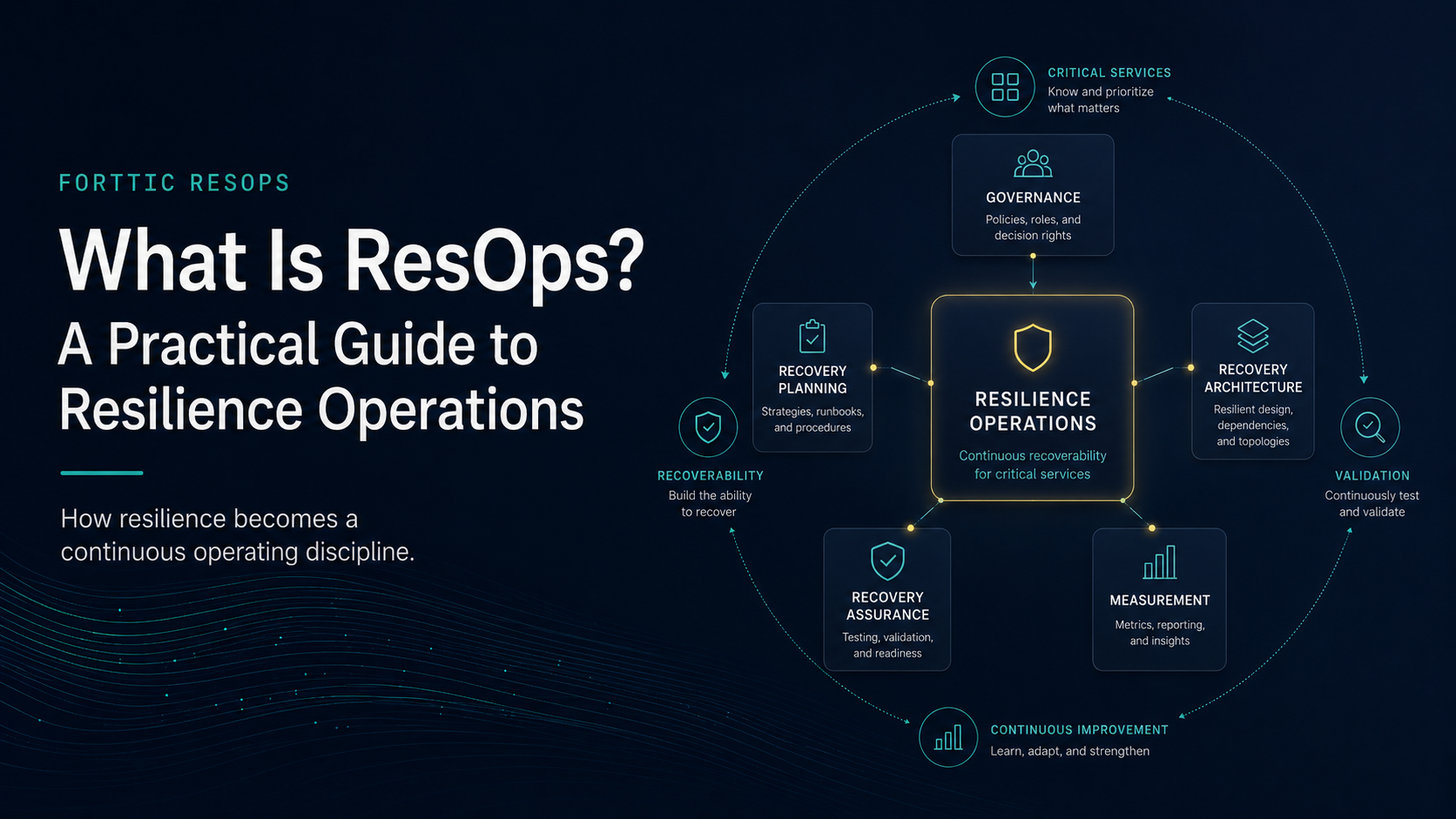
For years, most organizations have treated resilience as a collection of related but separate practices.
Backup teams protect data. Disaster recovery teams prepare recovery procedures. Security teams respond to cyber incidents. Infrastructure teams maintain availability. Business continuity teams determine how the organization should operate through disruption.
Each function matters. The problem is that a real disruption rarely respects those boundaries.
A ransomware incident can compromise production systems and backup credentials at the same time. A cloud outage can expose dependencies that were absent from the last disaster recovery test. An application may restore successfully while the identity, networking, or data services it depends on remain unavailable. A recovery plan can be technically correct and still fail to restore the business service within the disruption the organization can actually tolerate.
This is the problem that Resilience Operations, or ResOps, is beginning to address.
ResOps treats resilience as an ongoing operating discipline rather than something an organization prepares for periodically and invokes only after something has gone wrong.
Its central question is not simply Do we have backups? or even Do we have a recovery plan?
It is: Can our critical services withstand disruption and recover to an acceptable state—and can we prove that remains true as the environment changes?
That shift has implications for how organizations govern resilience, design recovery architecture, assign ownership, test recovery, measure readiness, and respond when actual resilience begins to diverge from policy.
A practical ResOps model should answer five questions continuously:
What services must recover?
What level of disruption can the business tolerate?
Are the systems and data those services depend on protected appropriately?
Can recovery actually be completed under realistic conditions?
When reality drifts from the required resilience state, how is that gap identified and closed?
That last question becomes particularly important as ResOps matures. Continuous visibility tells an organization where resilience is weakening. Continuous validation provides evidence that recovery works. Continuous enforcement addresses what happens when the live environment no longer satisfies the resilience policy.
Why ResOps is emerging now
ResOps is not emerging because organizations suddenly discovered backup or disaster recovery. Those disciplines have existed for decades. What has changed is the environment around them.
Enterprise technology estates are increasingly distributed across public clouds, SaaS platforms, traditional infrastructure, identity systems, data platforms, endpoints, and multiple protection technologies. The business services that depend on those systems often cross organizational and technical boundaries.
At the same time, the types of disruption organizations prepare for have expanded.
A conventional infrastructure failure might require restoring a server or failing over a data center. A cyberattack can require teams to determine whether credentials are compromised, which recovery points are trustworthy, whether restored systems are clean, what data was affected, and which services should be brought back first.
AI adds another source of operational change. Veeam's recent “Intelligent ResOps” work, for example, focuses on connecting data, identity, AI activity, and recovery context so teams can understand what changed and recover more precisely rather than performing broad restores.
The result is that resilience can no longer comfortably exist as an annual plan owned by one team. The underlying systems change too frequently. ResOps brings resilience into the operational lifecycle so that readiness can change when the environment changes.
What does ResOps actually mean?
The term is still emerging, so organizations and vendors describe its boundaries somewhat differently.
Commvault defines ResOps as a cross-functional operational discipline that brings security, infrastructure, and operations teams together around critical services, resilient system design, continuous validation, and measurable recovery. Its framework currently organizes the discipline around five domains: resilience governance, recovery planning, recovery architecture, recovery assurance, and resilience measurement.
Veeam describes ResOps more broadly as the combination of people, processes, and technologies used to protect, detect, recover, validate, and optimize data, systems, identities, and critical business services.
The exact taxonomy is less important than the underlying shift. A practical definition is:
ResOps is the continuous operating discipline for keeping critical business services recoverable as technology, threats, and business requirements change.
The emphasis is on three words.
Continuous
Resilience is reassessed as systems and risk change rather than only during scheduled exercises.
Operating
Resilience becomes part of normal technology operations rather than remaining solely an incident-response concern.
Discipline
ResOps includes governance, ownership, architecture, testing, measurement, and improvement. It is not simply another software category.
ResOps starts with critical services, not backup jobs
One of the most important changes in ResOps is the level at which resilience is considered.
Traditional backup operations tend to begin with infrastructure. Which servers are protected? Which databases have backups? Did yesterday's jobs succeed? How many restore points exist?
These questions are necessary, but the business does not ultimately consume backup jobs. It consumes services.
A payment platform may depend on applications, databases, identity services, network connectivity, secrets, storage, external APIs, and several cloud resources. Restoring only the database does not necessarily restore the payment service.
A ResOps model therefore begins higher in the stack: Which services are important enough that disruption creates material business impact? Then: What does each service depend on?
Only after those questions can the organization determine what protection and recovery capabilities are actually required.
This changes prioritization. Two applications can have technically similar backup policies while having very different consequences if they become unavailable. ResOps connects recovery decisions to business criticality rather than treating every protected object as equally important.
Impact tolerance changes how recovery is designed
RTO and RPO remain useful concepts. Recovery Time Objective describes how quickly a workload should be restored. Recovery Point Objective describes how much data loss may be acceptable.
But ResOps increasingly considers a broader question: How much disruption can the business service actually tolerate?
That may include downtime, degraded functionality, loss of transactions, customer impact, regulatory consequences, financial exposure, or dependency failures. This is the idea behind an impact tolerance.
An impact tolerance begins from the business consequence and works backward into technology requirements. Suppose a service can tolerate no more than two hours of meaningful disruption. That requirement can then influence recovery architecture, backup frequency, copy placement, immutability requirements, recovery testing frequency, staffing, dependency restoration, failover design, and escalation thresholds.
ResOps therefore connects the business expectation of resilience with the engineering mechanisms intended to produce it.
ResOps is broader than disaster recovery
Disaster recovery is an important part of ResOps, but the terms are not interchangeable. Traditional DR is primarily concerned with restoring technology after a disruptive event. ResOps includes recovery, but extends before and after the recovery event.
Before disruption, teams need to understand critical services, assess current protection, detect changing risk, validate controls, test recovery, and resolve weaknesses. During disruption, they need context about affected services, dependencies, trusted recovery points, priorities, and available recovery paths. After disruption, they need evidence of what happened, how successfully services recovered, which controls failed, and what should change.
Disaster recovery
How systems will be restored
Primarily invoked after disruption. Plans, runbooks, and failover for technology recovery.
ResOps
How recoverability is maintained
Continuous operational capability: governance, architecture, assurance, measurement, and action before, during, and after an incident.
This is also why ResOps overlaps with—but is not identical to—business continuity and cyber resilience. Business continuity is broader than technology recovery and covers how the organization continues delivering important activities through disruption. Cyber resilience addresses the ability to withstand, respond to, and recover from cyber events. ResOps sits closer to the operational machinery that continuously makes technology and service recoverability measurable, testable, and actionable.
The core capabilities of a ResOps model
There is not yet one universal ResOps standard, but several capabilities consistently appear across current frameworks and industry thinking.
01 · Governance
Resilience governance
Someone has to define what “resilient enough” means. That requires policies, ownership, business priorities, risk appetite, escalation rules, and decision authority. Without governance, recovery technology can become technically sophisticated while still operating without a consistent business objective. ResOps gives teams a shared model for deciding which services matter most, what requirements apply to them, and who is accountable for maintaining those requirements.
02 · Planning
Recovery planning
Recovery planning translates business priorities into executable recovery strategies. It defines what must recover, in what sequence, under which scenarios, and within what limits. The important ResOps shift is that these plans should not become static documents. They need to evolve as services, dependencies, architecture, and risks change.
03 · Architecture
Recovery architecture
Recovery requirements need technical mechanisms behind them: backup architecture, replicas, immutable copies, geographic separation, isolated recovery environments, identity recovery, and cross-cloud protection. In a multi-vendor organization, those mechanisms may span several products and cloud services. ResOps has to reason across the recovery architecture rather than treating each product as its own isolated resilience boundary.
04 · Assurance
Recovery assurance
A configured recovery architecture is not proof that recovery will succeed. Can the backup actually be restored? Is the recovery point trustworthy? Can the application start correctly? Can its dependencies recover? Does the restored service satisfy the required recovery objective? Continuous or frequent recovery testing is becoming central to modern resilience programs. Assurance replaces assumption with evidence.
05 · Measurement
Resilience measurement
If resilience is going to be operated continuously, it needs measurable outcomes. RTO and RPO still have a role, but they cannot describe the entire state of resilience. Measure the recovery outcome, not simply the amount of recovery activity.
Organizations may also need to understand percentage of critical services with verified recovery, time since the last successful recovery validation, duration of unresolved resilience drift, immutability coverage, recovery-policy compliance, clean recovery confidence, service-level recovery performance, and evidence freshness.
Commvault's ResOps work, for example, is promoting measures such as Service Resilience Indicators and Mean Time to Clean Recovery as ways to move resilience reporting toward recoverability outcomes. The broader principle matters more than any individual metric.
ResOps is fundamentally cross-functional
Technology resilience has historically been split among teams. Backup administrators know the protection environment. Infrastructure teams understand platforms. Cloud teams understand cloud architecture. Security teams understand threats and incident context. Application owners understand service dependencies. Business continuity teams understand business impact. Compliance teams understand regulatory obligations.
During normal operations, those boundaries can be manageable. During a major incident, they become expensive. Teams spend time establishing what is affected, who owns it, which recovery path is valid, what should recover first, and who has authority to make the necessary changes.
ResOps attempts to create those relationships before an incident. This does not necessarily mean creating a large new ResOps department. In many organizations, the better model will be a shared operating structure spanning existing teams.
The objective is not organizational centralization for its own sake. It is decision clarity. Everyone should know what needs to be protected, what acceptable recovery looks like, who owns each part of the process, and how evidence is produced.
What does continuous ResOps look like in practice?
Imagine a Tier-1 service with a policy requiring:
- three copies of important data
- two different storage or media types
- one copy outside the primary failure domain
- one immutable or offline copy
- verified recoverability with no known recovery errors
That is essentially the logic behind 3-2-1-1-0.
A periodic model might verify that policy during implementation and review it several months later. A ResOps model treats the requirement as an ongoing condition.
If a new workload becomes part of the service, the resilience model should recognize that dependency. If a secondary copy disappears, the organization should know. If an immutable retention configuration changes, the change should become visible. If a recovery test begins failing, confidence in the service's recoverability should decrease. If the underlying business criticality changes, recovery requirements should be reassessed.
This produces a recurring loop:
Understand Protect Observe Validate Improve
The important characteristic is feedback. Resilience is not certified once. It is continuously compared against the state the organization requires.
The next maturity step: from observable ResOps to enforced ResOps
Continuous visibility and validation represent major improvements over periodic recovery planning. But they expose another operational problem.
Suppose the ResOps program discovers that a Tier-1 workload no longer has the immutable recovery copy required by policy. The issue has been detected. The organization now knows that its resilience state has deteriorated. But what happens next?
Does an alert get generated? Does someone open a ticket? Which team receives it? How quickly do they understand the issue? Does the remediation require approval? Who performs the change? Does anyone verify that the required state was actually restored?
This is the point where observation becomes an execution problem. In our first FortticResOps article we described this as the ResOps enforcement gap: the distance between the resilience state an organization requires and the state that currently exists after drift occurs. Once that gap is visible, practical backup remediation metrics keep ownership, verification, and aging findings honest.
Continue exploring FortticResOps
ResOps Needs an Enforcement Layer
Continuous validation tells you whether resilience works. The next question is what happens when the required state drifts—and how the organization gets back to it.
Read the perspective →ResOps establishes the broader discipline. Continuous Resilience Enforcement, or CRE, addresses this specific part of the operating loop by connecting discovery and assessment to governed remediation, verification, and evidence. See the CRE Framework for how that loop runs in practice.
ResOps
How resilience should operate
The broader operating model: people, process, architecture, assurance, measurement, and ownership around critical services.
CRE
How the required state stays true
One capability inside ResOps: discover drift, assess it, enforce an approved response, verify the restored state, and retain evidence.
That does not make the two synonymous. ResOps remains the broader operating model. Enforcement is one capability a mature ResOps program increasingly needs.
What ResOps is not
Because the term is still emerging, it is useful to establish a few boundaries.
-
Not another name for backup
Backup is one technical capability inside the resilience architecture.
-
Not simply disaster recovery automation
Automation can execute recovery workflows, but ResOps also includes governance, service context, ownership, assurance, and measurement.
-
Not just a dashboard for resilience posture
Visibility is important, but the operating discipline must also determine what should happen when posture deteriorates.
-
Not necessarily a new organizational silo
The discipline should connect existing teams around shared recovery outcomes rather than create another isolated group.
-
Not a product that can be purchased and considered complete
Technology can support ResOps, but the operating model still requires policy, accountability, architecture, testing, decision authority, and continuous improvement.
How should an organization start with ResOps?
A ResOps program does not need to begin with an enterprise-wide transformation. A more practical starting point is to choose a small number of critical services and ask a disciplined set of questions.
What must remain recoverable?
Identify the services whose prolonged disruption would create material business impact.
What does acceptable recovery mean?
Define impact tolerance, RTO, RPO, clean recovery requirements, data integrity expectations, and regulatory constraints.
What does each service depend on?
Map the applications, data, identity, cloud resources, infrastructure, and external dependencies required for recovery. Forttic’s recovery dependency mapping guide turns that inventory into a testable service journey.
How is that dependency set currently protected?
Evaluate backup, replication, immutability, geographic separation, access controls, and other recovery mechanisms.
When was recovery last proven?
Move beyond successful jobs toward actual restore and service-level validation.
What happens when policy drifts?
Define ownership, escalation, approval, remediation, verification, and evidence.
That final question often reveals the biggest gap. Many organizations already possess the technology needed to detect resilience problems. Far fewer have turned the response to those problems into a continuous operating loop.
The future of ResOps is likely to become more autonomous—but not less governed
As environments become more dynamic, manually operating every resilience control becomes increasingly difficult. This is where AI agents and other forms of automation are likely to become more important.
But autonomous resilience should not mean unrestricted autonomy. An agent may be able to detect that an immutable copy is missing, determine why it happened, identify a known remediation, execute the change, verify the resulting state, and preserve an audit record. That can make sense for a bounded, reversible, well-understood decision.
A change affecting a critical recovery architecture or destructive recovery action may require human authorization. The future of ResOps is therefore likely to depend on bounded autonomy.
Machines can handle more of the continuous operational work while humans retain authority over decisions where business impact, uncertainty, or irreversibility is high. That is also why context matters. An agent does not simply need access to an API. It needs to understand policy, business criticality, current state, past decisions, approval boundaries, and expected outcomes.
The trajectory is not from ResOps to “AI does everything.” It is from manual resilience operations toward increasingly continuous, contextual, governed execution. How Forttic bounds those decisions is covered in How Forttic Decides.
ResOps turns recovery readiness into an operating property
The most useful way to understand ResOps is not as another acronym. It represents a change in how resilience is managed.
Traditional resilience programs often ask whether the necessary plans and technologies exist. ResOps asks whether recoverability remains true.
That distinction becomes increasingly important as infrastructure changes faster, threats become more disruptive, recovery environments become more heterogeneous, and business tolerance for extended outages decreases.
A mature ResOps program should be able to connect a critical business service to its recovery requirements, protection architecture, current resilience state, most recent validation, outstanding drift, responsible owners, and evidence.
And when one of those conditions stops being true, the operating model should know what happens next.
That is where resilience stops being a document describing what an organization hopes will happen. It becomes a continuously managed business capability.
Frequently asked questions
What does ResOps stand for?
ResOps stands for Resilience Operations. It describes an emerging operating discipline for continuously managing, validating, measuring, and improving an organization's ability to withstand disruption and recover critical services.
What is the difference between ResOps and disaster recovery?
Disaster recovery focuses primarily on restoring technology after disruption. ResOps is broader and continuous. It covers the governance, service prioritization, architecture, readiness, validation, measurement, ownership, and operational processes required to maintain recoverability before, during, and after an incident.
Is ResOps the same as cyber resilience?
No. Cyber resilience is the broader ability of an organization to withstand and recover from cyber disruption. ResOps is an operational approach that can help put parts of that resilience objective into continuous practice, particularly around technology and service recoverability.
Is ResOps a software category?
ResOps is better understood as an operating discipline rather than a single software category. Backup, recovery, security, monitoring, orchestration, validation, and resilience-enforcement technologies can all support a ResOps program.
Who owns ResOps?
Ownership will vary by organization. ResOps usually requires collaboration across infrastructure, backup/recovery, security, cloud, application, business continuity, risk, and compliance teams. The important requirement is clear accountability for critical-service recoverability rather than a specific organizational chart.
What should ResOps teams measure?
Useful measures can include recovery performance, verified recovery coverage, time since successful validation, unresolved resilience drift, clean recovery confidence, protection-policy adherence, evidence freshness, and the percentage of critical services operating within defined impact tolerances.
How does Continuous Resilience Enforcement relate to ResOps?
ResOps is the broader operating discipline. Continuous Resilience Enforcement focuses on what happens when the live resilience state deviates from required policy: discovering the drift, assessing it, executing an approved response, verifying that the desired state has been restored, and retaining evidence. See the CRE Framework.